Ask ten rice buyers what separates White Sella Rice from Creamy Sella Rice, and most will give you a different answer. Some think they’re the same grain with two names. Others assume colour is just a packaging choice. Neither is true.
The difference comes down to how the rice is processed after parboiling specifically, how much of the natural bran layer is removed. This single step changes the colour, the aroma, the texture after cooking, and even which export markets prefer one over the other. For buyers sourcing in bulk, getting this distinction right matters more than it seems.
How Sella Rice is Made
Before getting into the differences, it helps to understand what “Sella” actually means. Sella rice starts as raw paddy, still inside its husk. This paddy goes through a parboiling process — it’s soaked, then steamed while the husk is still intact, and finally dried before milling.
This steaming step pushes nutrients from the outer bran layer into the grain itself, which is why parboiled rice holds up better during cooking and stays separate instead of turning sticky.
Both White Sella rice and Creamy Sella rice begin this exact same way. The real difference shows up later, in how much polishing each type goes through after parboiling. That’s where the two paths split.
What is White Sella Rice
White Sella Rice is a heavily polished variety of parboiled rice, known for its clean white colour and smooth, uniform grain appearance.
This polish level is what defines it:
- Heavy polishing — Most of the outer bran layer is removed after parboiling.
- Uniform white colour — Clean, consistent appearance across the batch.
- Smoother grain surface — Refined finish suited for export and retail packaging.
- Higher AGL (average grain length) — Premium grades show the long, slender shape typical of export-quality basmati.
- Milder aroma — Less bran means a subtler fragrance compared to less-polished rice.
- Better shelf stability — Polishing extends storage life, useful for bulk shipments.
- Trade-off — One natural nutrition is lost in exchange for consistency and visual uniformity.
What is Creamy Sella Rice
Creamy Sella Rice is a lighter-polished variety of parboiled rice. It goes through less milling than White Sella, so more of the natural bran layer stays on the grain. This is what gives it a golden-creamy tinge instead of pure white, along with a stronger natural aroma.
This polish level is what defines it:
- Light polishing — Only a portion of the bran layer is removed after parboiling.
- Golden-creamy colour — Retained bran gives a soft tinge instead of clean white.
- More natural texture — Slightly rougher grain surface, less refined finish.
- Higher nutrition retention — More bran means more of the natural fiber and nutrients stay intact.
- Stronger aroma — Closer to traditional processing, so the natural fragrance is more pronounced.
- Shorter shelf life than White Sella — Retained bran oils make it slightly more prone to rancidity over long storage.
- Trade-off — Less uniform appearance, but better nutrition and flavour retention.
Why Does the Colour Actually Different?
Both White Sella and Creamy Sella start with the exact same process of soaking, steaming, and drying. So why does one come out bright white and the other golden? It comes down to three things.
- Soaking duration: The longer the paddy soaks, the more pigment from the bran layer moves into the grain.
- Steam pressure and intensity: Stronger, more intense steaming pushes the grain toward a darker tone.
- Drying temperature and method: Slower drying at lower heat tends to keep the grain lighter. Faster drying at higher heat deepens the golden colour.
White Sella is made using lighter steaming, combined with extra polishing after milling this removes more of the surface pigment, leaving a brighter white grain. Creamy Sella uses slightly deeper steaming and less polishing, which keeps more of the natural golden tone intact. Neither version is more processed than the other. They are simply calibrated to reach a different result.
| Decision Factor | White Sella Rice | Creamy Sella Rice |
|---|---|---|
| Best Suited For | Retail packaging, export shipments needing visual consistency | Buyers prioritizing natural processing and flavour |
| Common Grades Available | 1121, 1509, Pusa (heavily polished variants) | 1121, Traditional, Sharbati (lightly polished variants) |
| Export Market Demand | Higher demand in markets that value uniform white grain (Gulf, Europe retail) | Preferred in markets focused on traditional/natural rice (parts of South Asia, niche health-conscious buyers) |
| Price Tier | Slightly higher (extra milling cost) | Slightly lower to moderate |
| Packaging Sensitivity | More stable across longer transit/storage | Needs tighter storage control due to retained bran oils |
| Ideal Order Volume | Works well for large, standardized bulk orders | Often ordered in smaller, specialty-focused batches |
How to Tell Them Apart Just by Looking
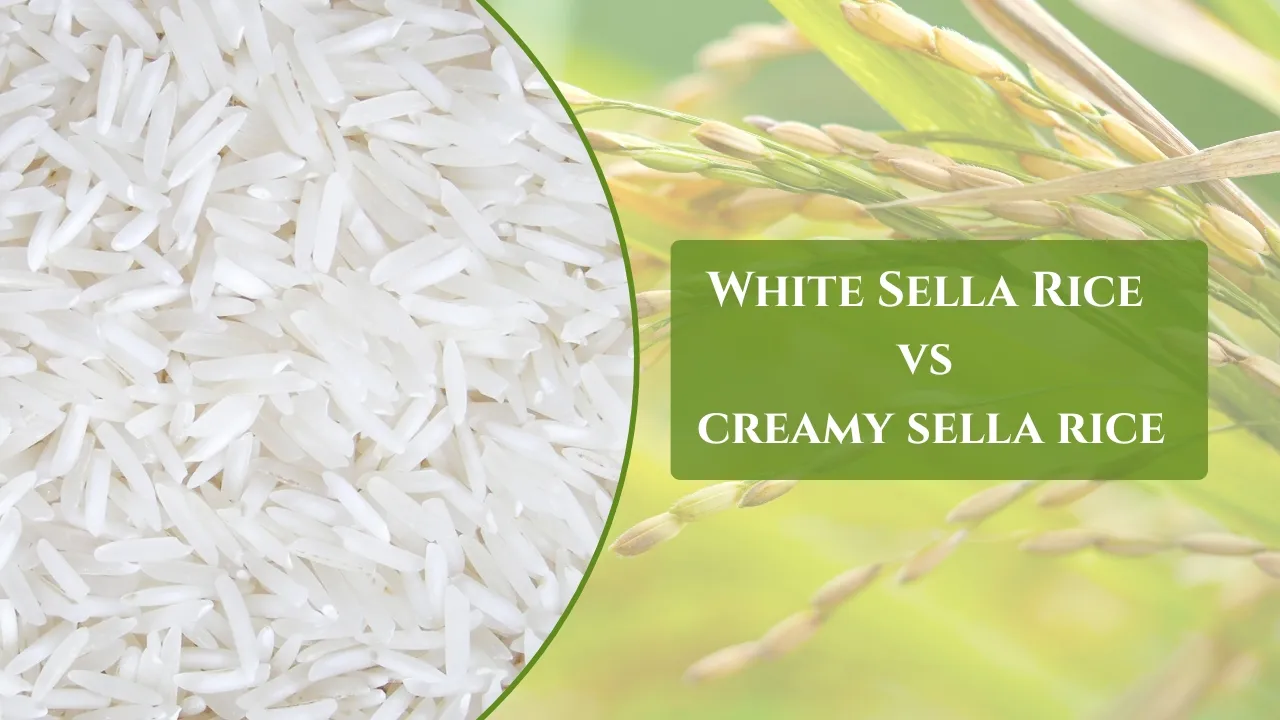
If you place both grains side by side in daylight, the difference becomes obvious within seconds. White Sella has a smooth, polished look with an almost translucent white tone; it looks closer to regular milled rice at first glance.
Creamy Sella is slightly more opaque, with a visibly warmer golden-yellow shade, even before it touches water or heat. The difference holds up after cooking too. White Sella turns bright white once cooked. Creamy Sella keeps its soft golden hue, giving the final dish a slightly different visual character on the plate.
Cooking Behaviour: Does the Colour Affect the Taste or Texture?
Both grains cook to a similar length and elongation, since the same parboiling process drives that result, not the colour.
White Sella tends to cook slightly firmer, with a clean bite that holds its shape well. This makes it a good fit for retail packaging and fine dining presentation, where appearance matters as much as taste.
Creamy Sella cooks marginally softer, with a more traditional mouthfeel. This is exactly why it is so often preferred for dishes like biryani, mandi, and kabsa meals where a heartier, more comforting texture is expected. Water absorption and cooking time stay nearly identical for both. The real difference shows up in the final colour and a subtle shift in texture, not in how long either one takes to cook.
Conclusion
White Sella and Creamy Sella come from the exact same process; only the steaming intensity and polishing level set them apart. Neither one is better than the other. Each simply suits a different region, kitchen, and visual preference. Knowing this difference helps make sense of something many buyers and cooks wonder about why the same Basmati variety can look and feel slightly different depending on where and how it was processed.
FAQs
Q1: What are the different types of Sella rice?
Ans: Sella rice has two main types: White Sella and Creamy Sella. Both are parboiled Basmati — White Sella is brighter and more polished, while Creamy Sella has a natural golden tone.
Q2: Is Sella rice better than white rice?
Ans: It depends on comparison. Sella offers firmer texture, longer shelf life, and better elongation than raw Basmati. Between White and Creamy Sella, neither is “better” — they suit different cooking styles.
Q3: Which Sella rice is best for biryani?
Ans: Creamy Sella is generally preferred for biryani, mandi, and kabsa. Its softer texture after cooking gives a heartier, more traditional mouthfeel suited to rich, layered dishes.
Q4: Can you make biryani with Sella rice?
Ans: Yes. Sella rice is a popular biryani choice because its hardened grain structure holds up well during long, slow cooking without breaking or turning mushy.
Q5: Is Sella rice better than Basmati?
Ans: Not an accurate comparison — Sella is itself a type of processed Basmati. The real comparison is between processing forms: Raw, Steam, Sella, and Golden Sella.
Q6: What is 1121 Sella rice?
Ans: 1121 Sella is the parboiled version of the 1121 Basmati variety, one of India’s most exported long-grain types. It’s available in both White Sella and Creamy Sella forms.