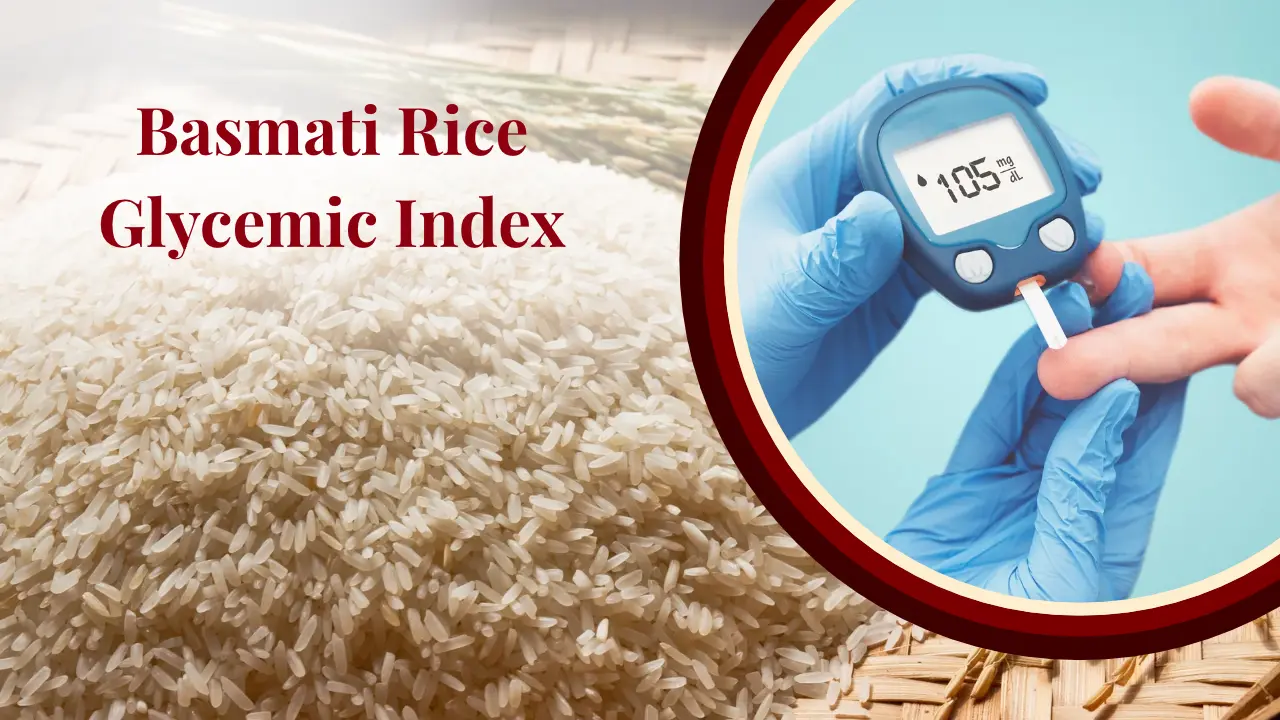
The basmati rice glycemic index is roughly 43 to 69, which runs from the low range to the high range. But this number is not fixed, because it changes with the rice type, how it is processed and how you cook it. You will see a GI chart of basmati rice types, learn what can lower the GI, and find easy ways to eat basmati rice.
What Is the Glycemic Index of Basmati Rice?
The glycemic index (GI) shows how fast a food raises blood sugar. Low is 55 or less, medium is 56 to 69, and high is 70 or more. In the University of Sydney GI database, tested basmati sits in the low to medium band. Some people also search this as the glucose index of basmati rice.
Basmati Rice Glycemic Index Chart by Type and Variety
This chart lists the GI values found in published lab tests.
| Basmati type or variety | Glycemic Index value | Category |
|---|---|---|
| Pusa Basmati 1121, raw | 58.41 | Medium |
| Pusa Basmati 1121, soaked at 80°C | 54.31 | Low |
| Pusa Basmati 1121, steamed | 47.04 | Low |
| Traditional basmati, thermally treated | Below 55 | Low |
| Pusa Basmati 1509 | No GI test found | Not rated |
| 1718, 1401 and Sugandha basmati | No GI test found | Not rated |
Why Basmati Rice Has a Lower Glycemic Index
Two things can give basmati rice a lower glycemic index: the starch inside the grain and how the rice is treated before cooking.
- Amylose: Amylose is a type of starch. Un-soaked Pusa Basmati 1121 had 27.26% apparent amylose, and in one study, basmati with more amylose had a lower GI.
- Soaking and steaming: Heat treatment, such as soaking in hot water or steaming, changes the starch and lowers the GI. In lab tests on Pusa Basmati 1121, the GI went from 58.41 to 54.31 after soaking at 80°C, and to 47.04 after steaming. Another study on thermally treated Indian basmati found a sample with a GI below 55.
- People and tests: GI is measured in people, so results change between tests. One study found a mean GI of 59 for basmati, with large differences between people.
- Labels: Dr. Chan of The Daily Dose says not every basmati is low GI, so only lab-tested brands should be called that.
Does Basmati Rice Spike Blood Sugar?
Yes, it can, because basmati is a carb food. But steamed basmati tested low, and a few habits can keep the rise smaller. Cooling and reheating may help. In a study of 15 healthy adults, white rice cooled for 24 hours at 4°C and then reheated gave a lower blood sugar rise than fresh rice. Portion and pairing matter too. A bigger plate means more carbs, and in one study, white rice eaten with chicken, oil and vegetables gave a lower rise than rice alone.
| Myth | Fact |
|---|---|
| Basmati never spikes blood sugar | A lower GI still raises blood sugar, mostly in big portions |
| Rice alone is fine | Rice with protein, vegetables and some fat gave a lower rise in one study |
Can Diabetics Eat Basmati Rice?
Diabetes UK lists basmati rice as a medium GI food and says to choose basmati or brown rice instead of white rice. Its Diabetes UK carbohydrate guidance also says wholegrain foods are usually better for blood sugar, because they tend to have a lower GI.
Basmati rice has almost no sugar. But it is mostly starch, and the body breaks starch down into glucose, so portion size still matters.
So basmati can fit in a diabetes meal plan. Diabetes UK counts a cooked rice portion as about 180 g, or two cupped hands. Blood sugar responses differ from person to person, so a doctor or dietitian can help you set your own portion.
Nutritional Content of Basmati Rice
Basmati rice is mainly a source of carbs, with some protein and very little fat. This table shows raw white basmati.
| Nutrient | Per 100 g raw white basmati |
|---|---|
| Calories | 351 kcal |
| Carbohydrates | 84 g |
| Sugars | 0.1 g |
| Fibre | 1.1 g |
| Protein | 8.1 g |
| Fat | 0.5 g |
Cooked rice holds water, so 100 g of cooked basmati has about 25 g of carbs. Values differ by a few grams between brands.
What Is New in 2025 and 2026 on Basmati Rice Glycemic Index?
New work in 2025 looks at why rice GI differs. A study in the Indian Journal of Genetics and Plant Breeding found Pusa Basmati 1509 had the highest amylose, 25.01%, of the rice tested. Another 2025 study found GI also depends on starch granule size and packing. These studies explain GI. They do not replace the lab-tested values in the chart above.
FAQs
Q1: What is the exact glycemic index of basmati rice?
Ans: Tested values run from about 43 to 69, depending on the variety, how it is processed and who is tested.
Q2: Does basmati rice spike blood sugar?
Ans: It can, because it is a carb food. Smaller portions with vegetables and protein give a smaller rise.
Q3: Which basmati rice has the lowest Glycemic Index?
Ans: In our chart, steamed Pusa Basmati 1121 is lowest at 47.04. In one study, red basmati tested lower than white.
Q4: Does washing basmati rice lower its Glycemic Index?
Ans: No study we found shows that washing lowers Glycemic Index. Washing only rinses off surface starch.
Q5: Is basmati rice full of sugar?
Ans: No. Raw white basmati has about 0.1 g of sugar per 100 g. Most of its carbs are starch.
Q6: Can I eat basmati rice every day with type 2 diabetes?
Ans: Many people do, in small portions with vegetables and protein. A doctor or dietitian can set the right amount.
Conclusion
The basmati rice glycemic index is not one fixed number. Tests show about 43 to 69, and steamed basmati tested lower. To keep the rise in blood sugar smaller, choose lab-tested or steamed basmati, keep cooked portions near 180 g, and eat it with vegetables and protein.