Standing in the rice aisle, most people pause at the same question: Sona Masoori rice vs Basmati, which one to pick? Both are staples in Indian kitchens, but online sources often give conflicting information, especially around health claims and glycemic index numbers. This creates confusion instead of clarity. This guide breaks down the real differences between the two rice varieties, checks the facts that are commonly repeated online, and gives you a simple way to decide which one fits your kitchen and your meals.
What is Basmati Rice
Basmati rice comes from the Himalayan foothills, grown mainly in Punjab, Haryana, and Uttarakhand in India, as well as parts of Pakistan. The name “Basmati” comes from Hindi and Sanskrit, meaning “fragrant,” which points to its most recognized trait. It is a long-grain rice, and much of its texture comes from aging. Freshly harvested Basmati is usually aged for a few months before it reaches the market, which reduces moisture and helps the grains elongate further during cooking.
This is why aged Basmati tends to cook longer and separate more compared to fresh stock. Basmati is commonly used in biryani, pulao, and other festive or special-occasion dishes where the rice itself is meant to stand out.
What is Sona Masoori Rice
Sona Masoori is grown mainly in Andhra Pradesh, Telangana, and Karnataka. The name comes from “Sona,” the Hindi word for gold, a reference to the light golden shade the grains take on after cooking. It is a medium-grain rice with a lighter texture compared to Basmati, and it does not need the same aging or soaking process before cooking. Sona Masoori is widely used in South Indian households as an everyday rice, pairing well with sambar, rasam, curd rice, and simple curry meals. It is less about presentation and more about being a reliable, easy-to-cook base for daily food.
Key Differences: Grain, Aroma, Texture, and Cooking
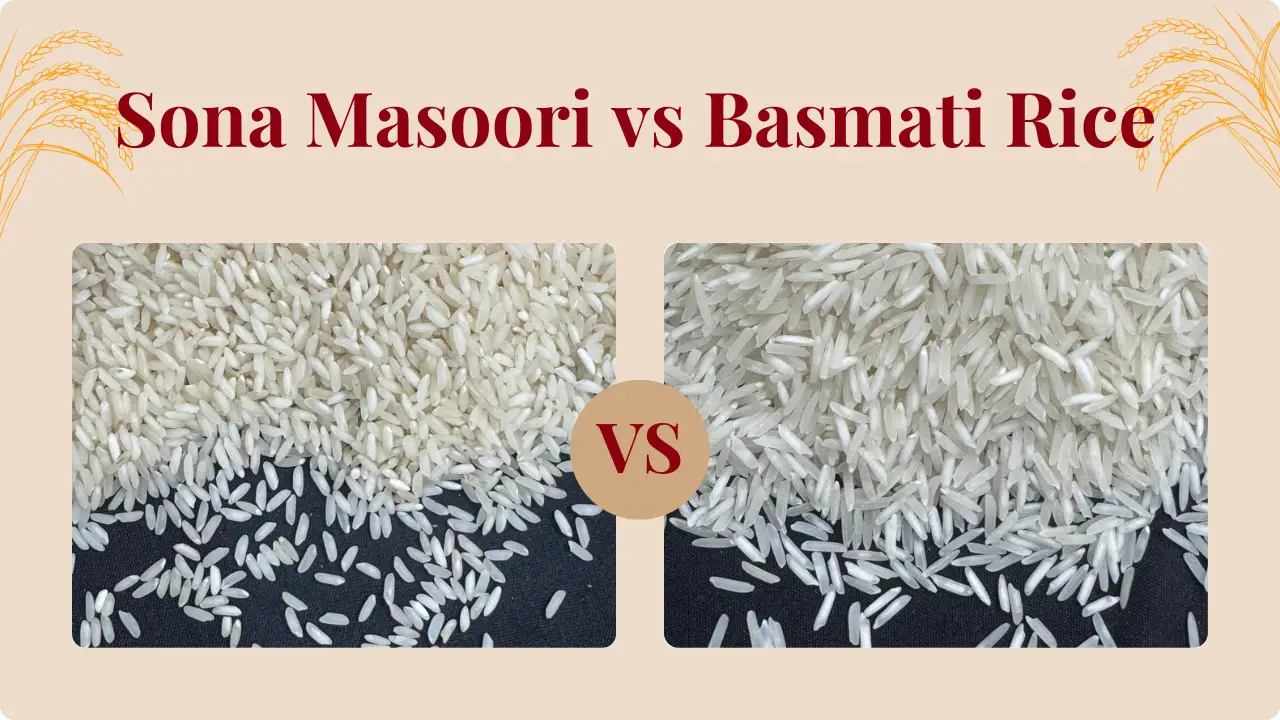
The differences between Sona Masoori rice vs Basmati go beyond just looks. Grain size, aroma, and cooking behavior all set them apart in ways that affect the final dish.
Basmati’s aroma is one of its most distinct features, and it comes from a natural compound called 2-acetyl-1-pyrroline, which is present in higher amounts in Basmati than in most other rice types. This gives it a strong, nutty fragrance that becomes more noticeable during cooking. Sona Masoori, on the other hand, has a much milder scent and does not carry the same aromatic intensity. Cooking behavior also differs. Sona Masoori cooks faster and needs less water, and it does not require soaking. Basmati usually needs soaking for 20 to 30 minutes before cooking and takes more water and time to cook properly.
If your meals need rice that blends into the plate, Sona Masoori works well. If the rice needs to stand out, like in biryani, Basmati is the better fit.
Glycemic Index of Basmati Rice vs Sona Masoori
One of the most searched questions is about the glycemic index of Basmati rice vs Sona Masoori, and it is also the most confusing part online. Different sources list different numbers, and some even contradict each other on which rice has the lower GI. This happens because the glycemic index is not fixed for a rice type. It changes based on the specific variety, how much the rice is polished, how it is cooked, and even how it is stored before cooking.
In general, most nutrition sources place both Basmati and Sona Masoori in the low to moderate glycemic index range compared to other white rice varieties, but exact numbers vary by study and by brand. This is why you will see different figures on different websites, and none of them should be treated as a fixed rule for every bag of rice.
For anyone watching blood sugar levels, portion size and what the rice is eaten with matter as much as the GI number itself. This is general dietary information, not medical advice, and anyone managing a health condition should check with a doctor or nutritionist for guidance specific to their needs.
How to Identify Authentic Rice
A few checks can help you spot good quality rice before you buy or right after cooking.
- Grain uniformity: Authentic Basmati has long, uniform grains. If the bag has a mix of short and long grains, it may be blended with a cheaper variety.
- Smell test: Basmati should have a noticeable aroma even in its raw form. A weak or absent smell can mean lower quality or an older, less aromatic batch.
- Cooking test: Real Basmati elongates and stays separate after cooking. If it turns sticky or clumps together, it may not be genuine aged Basmati.
- Sona Masoori check: Good Sona Masoori should cook soft without turning mushy or overly sticky. Excess stickiness can point to a lower grade or mixed batch.
- Color and polish: Overly white, shiny grains can indicate heavy polishing, which strips away some of the natural nutrient layer.
Making the Right Pick for Your Kitchen
- For everyday cooking: Sona Masoori fits better. No soaking, quicker on the stove, and pairs naturally with sambar, curd rice, or regular curries.
- For biryani, pulao, or special meals: Basmati works better. The aroma and grain length add to how the dish looks and feels, which matters for guests or festive cooking.
- For blood sugar management: There is no clear winner based on GI alone. Portion size and what the rice is served with play a bigger role than the rice type itself.
- For regular, high-volume cooking: Sona Masoori is more practical since it saves time on soaking and cooks faster in larger batches.
FAQs
Q1: Which is better for diabetes, Sona Masoori or basmati?
Ans: Neither is clearly better for diabetes. Both fall in a similar low to moderate GI range. Portion size and meal pairing matter more than the rice type alone.
Q2: Can we eat Sona Masoori rice daily?
Ans: Yes, Sona Masoori is commonly eaten daily in South Indian households. It cooks quickly and fits easily into regular meals without extra preparation.
Q3: Can we eat basmati rice daily?
Ans: Yes, basmati can be eaten daily. It is more commonly kept for special meals due to its aroma, but there is no issue eating it regularly in moderation.
Q4: Which rice is better for health, Sona Masoori or basmati?
Ans: Neither is universally healthier. Both offer similar carbohydrate content, and the right choice depends on your meal, portion size, and personal dietary needs.
Q5: What is the healthiest Indian rice?
Ans: There is no single healthiest rice. It depends on processing, portion size, and diet. Whole grain or less polished varieties generally retain more nutrients.