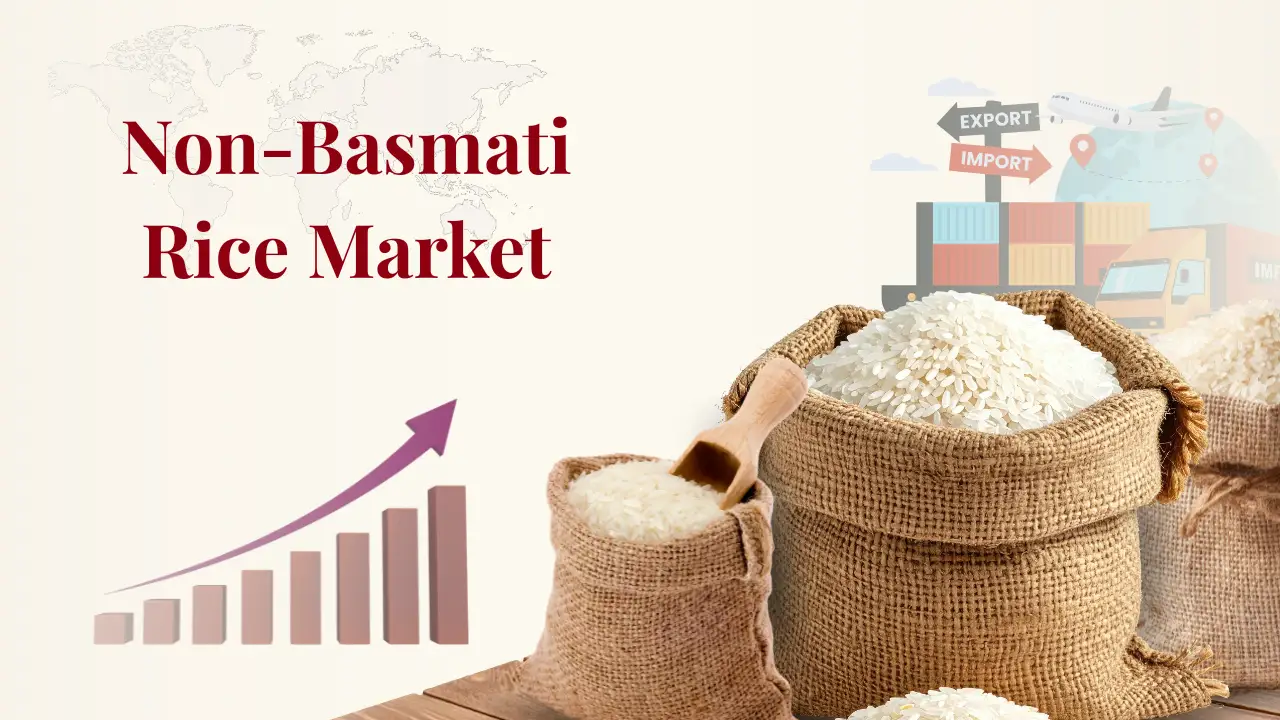
India’s non basmati rice market has grown strongly in recent years, driven by rising global demand for affordable and versatile rice varieties. Countries across Africa, the Middle East and Southeast Asia depend heavily on Indian rice for daily food needs. The market recently got a boost after the government lifted export restrictions on non basmati rice, allowing exporters to meet international orders again. This move has renewed buyer confidence and strengthened India’s position in the non basmati rice market.
India’s Role: Exports & Top Destinations
India grows a wide range of non basmati rice varieties, including Sona Masuri, IR-64, Kolam, Ponni and Jeera Sambha. These varieties are known for their quality, taste and suitability for different cooking styles. Non basmati rice exporters in India shipped 15.01 million metric tons of rice in 2025-26, valued at over Rs 51,892 crore. This shows the scale and strength of rice export from India. Benin remains the top buyer, accounting for 11.5% of exports, followed by Bangladesh, Guinea, Togo and Cote d’Ivoire. These non-basmati rice exports continue to support food security across Africa and South Asia.
Why India Leads the Non Basmati Rice Market
India’s Export Volume and Global Reach
India has built a strong global reach in the non basmati rice market. Favourable growing conditions, a wide variety of rice types and large-scale production give India an edge over other exporting countries. The rice reaches buyers across Africa and Asia, with Benin, Bangladesh and Guinea among the top destinations. Consistent supply, competitive pricing and established trade relationships have helped India build and maintain this leading position.
Popular Varieties Buyers Can Source
Buyers can source a range of non basmati rice varieties from India, including Sona Masuri, IR-64, Kolam, Jeera Sambha and Ponni. Each variety offers distinct grain size, texture and cooking properties suited to different markets. India also produces several GI-tagged rice varieties, which confirm regional authenticity and quality standards. This adds an extra layer of trust for buyers looking for genuine, traceable rice sources.
Sourcing Non-Basmati Rice for Your Business?
JMB Agro exports 12+ non-basmati varieties including Sona Masoori, Kolam, Ponni and Parmal to 25+ countries, backed by ISO, FSSAI and HACCP certification.
Global Market Size & Growth Trends
The global non basmati rice market was valued at USD 48.0 billion in 2024 and is projected to reach USD 61.31 billion by 2035, growing at a CAGR of 2.25%. This steady growth reflects the rising global reliance on non basmati rice as an affordable food staple. Several trends are shaping this growth. More consumers are shifting towards organic rice due to growing health awareness. E-commerce platforms are making it easier for buyers to access different rice varieties from various regions. At the same time, the food processing industry is using non basmati rice in snacks, ready-to-eat meals and other packaged products, adding another growth driver to the rice industry in India.
Looking ahead, these trends are expected to strengthen further. Organic and traceable rice will likely see stronger buyer interest, while e-commerce continues to widen access beyond traditional trade channels. For buyers, this signals a market that rewards early sourcing relationships and consistent quality, rather than one-off purchases based on price alone.
FAQs
Q1: Which country is the biggest exporter of non-basmati rice?
Ans: India is the world’s largest exporter of non-basmati rice, supplying major markets across Africa, the Middle East and Southeast Asia consistently.
Q2: Did India ban rice export?
Ans: Yes, India had restricted certain non-basmati rice exports earlier. The government later lifted these restrictions, allowing exporters to resume international shipments.
Q3: Is there a rice export ban in India in 2026?
Ans: No, the non-basmati rice export ban was lifted, and exports are currently active, with India shipping to multiple countries in 2025-26.
Q4: What is the best non-basmati rice in India?
Ans: Popular non-basmati varieties include Sona Masuri, IR-64, Kolam and Jeera Sambha, each valued for distinct grain quality and cooking properties.