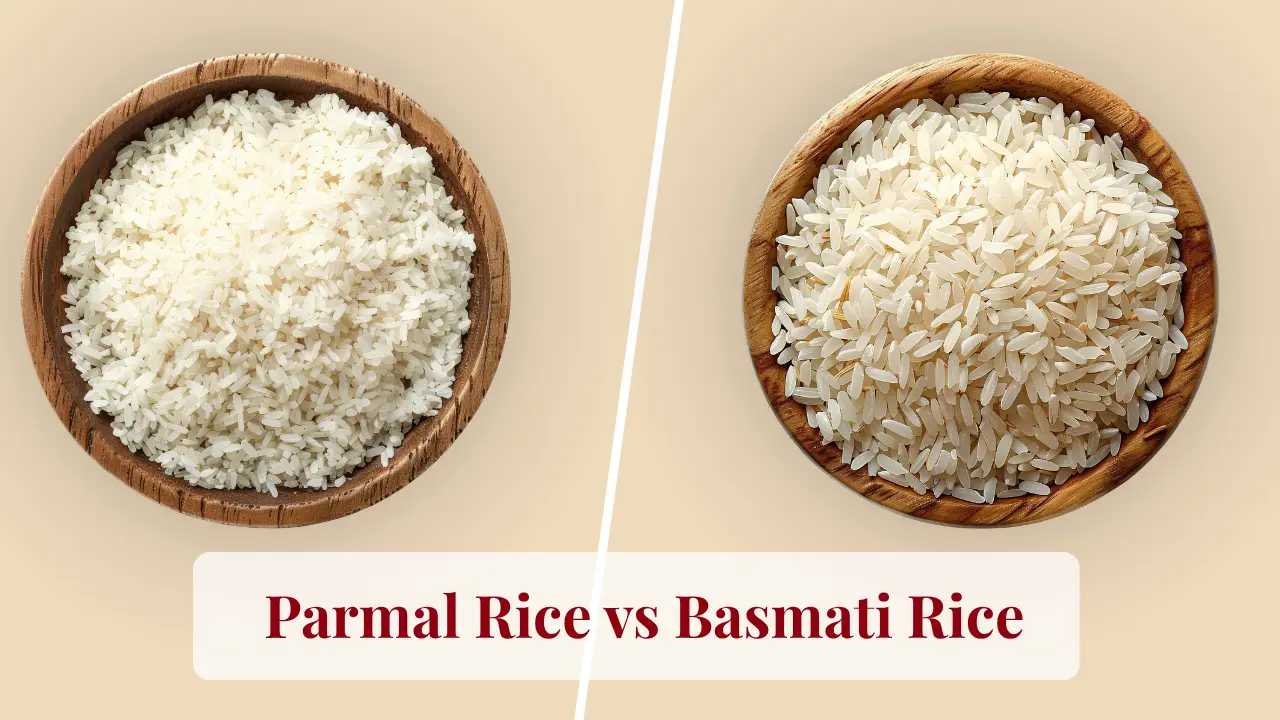
Parmal rice vs basmati rice is a common comparison for buyers who see both on the same supplier list. Both come in raw, steam and sella forms, and some sellers even list Parmal under basmati, so the two often get mixed up.
Parmal is a non-aromatic, non-basmati rice. Basmati is an aromatic, long-grain rice that carries a GI tag. They differ in grain length, aroma, texture and use, which is why the right choice depends on what you cook or supply. This guide explains the difference between Parmal and basmati rice in grain length, aroma, cooking, sella forms and nutrition, and helps you choose the right one for home use, catering or bulk supply.
Parmal Rice vs Basmati Rice: Quick Comparison
This table shows the main difference between Parmal and basmati rice, which some markets spell as parimal rice.
| Feature | Parmal | Basmati |
|---|---|---|
| Average grain length (AGL) | 6.40 to 6.50 mm | 8.30 to 8.35 mm (1121) |
| Aroma | Non-aromatic, neutral taste | Natural, nutty fragrance |
| Cooked texture | Soft in raw form, firmer in steam and sella | Fluffy, non-sticky, separate grains |
| GI tag | No basmati GI tag | Yes, Indian basmati holds a GI tag |
| Common forms | Raw, steam, sella (creamy and golden) | Raw, steam, sella, golden sella |
| Best use | Daily meals, khichdi, pulao, bulk cooking | Biryani, pulao, premium dishes |
| Typical buyer | Households, caterers, institutions | Restaurants, hotels, export buyers |
Grain Length: Where Parmal and Basmati Fit
On average, Parmal rice grain length is 6.40 to 6.50 mm, while 1121 basmati measures 8.30 to 8.35 mm. Parmal sits close to the line between medium and long grain, so some sellers describe it as medium grain rice and others as long grain rice.
Short, Medium and Long Grain Rice Explained
The International Rice Research Institute (IRRI) groups rice by grain length. Other standards use slightly different cut-offs.
- Short grain: 5.50 mm or less.
- Medium grain rice: 5.51 to 6.60 mm. Parmal, at 6.40 to 6.50 mm, sits at the upper end of this range.
- Long grain rice: 6.61 to 7.50 mm. Rice above 7.50 mm is called extra long, which is where 1121 basmati falls. You can compare other varieties in our guide to types of basmati rice.
Aroma, Texture and Cooking Difference
Aroma sets the two apart. Basmati rice aroma is natural and nutty, while Parmal has a neutral taste with no strong fragrance. Parmal rice texture depends on the form: raw cooks soft, steam stays firmer, and sella grains stay the most separate. Basmati cooks fluffy with separate grains. How to cook Parmal rice therefore varies by form, and the table compares the basics. For basmati methods in detail, see our basmati rice water ratio guide.
| Feature | Parmal | Basmati |
|---|---|---|
| Soak time | 30 minutes, optional | 30 minutes, optional |
| Water ratio | 1:1.5 unsoaked, 1:1.25 soaked | 1:1.5 unsoaked, 1:1.25 soaked |
| Cooking time | 12 to 15 minutes, then rest 5 to 10 minutes | 12 to 15 minutes, then rest 5 to 10 minutes |
| Cooked texture | Soft (raw), firmer (steam), separate (sella) | Fluffy, separate grains |
- Parmal: suits everyday dal chawal, khichdi and cooking in large batches, where aroma is not the main need.
- Basmati: suits biryani and pulao, where long separate grains and fragrance matter.
Which Is Healthier: Parmal or Basmati Rice?
Parmal and basmati are both polished white rice, so their nutrition is similar and mostly carbohydrate. Indian food composition tables list rice by form, such as raw milled, so the figures below describe raw milled rice in general and give a fair guide to Parmal rice nutrition.
| Per 100 g, raw milled rice | Typical value |
|---|---|
| Energy | About 345 kcal |
| Carbohydrate | About 78 g |
| Protein | About 7 g |
| Fibre | Low, as polishing removes the bran |
| Glycemic index (GI) | Varies by variety, milling and cooking |
No published GI value for Parmal could be found. A study of Indian and Pakistani basmati reported GI values from 43 to 64, depending on variety and cooking method, so the Parmal vs basmati glycemic index cannot be ranked with certainty. Milling and parboiling also change these numbers. See What Is Parmal Rice for the full Parmal table. Anyone managing a health condition should ask a doctor or dietitian.
Which Should You Choose: Parmal or Basmati?
- Households and retail: Choose Parmal for daily meals such as dal chawal and khichdi, where a neutral taste and soft texture work well. Choose basmati when aroma and long, separate grains matter, as in biryani and pulao for special occasions.
- Caterers and institutions: Sella Parmal suits large-batch cooking, as its grains keep their shape in bulk and when held warm. Basmati sella or golden sella suits hotels and buffets, where aroma and grain length are part of the presentation.
- Importers and distributors: For bulk parmal rice, orders start at one full container load (20 to 25 MT) in PP, non-woven or jute bags. PP bags come in 5 kg to 50 kg sizes, and private label and custom packaging are available. The HS code is 1006, with Parmal listed under 10063090.
JMB Agro Foods is a Parmal rice exporter and non basmati rice exporter in India, supplying from Taraori, Haryana. See the Parmal Rice and 1121 Basmati Rice for specifications.
FAQs
Q1: Is Parmal rice the same as basmati rice?
Ans: No. Parmal is a non-basmati rice with a neutral taste and shorter grains, while basmati is aromatic, long grain and carries a GI tag.
Q2: Is Parmal rice the same as PR 11 or PR 14?
Ans: In our range they are separate products. PR 11 averages 6.80 to 6.90 mm and Parmal 6.40 to 6.50 mm, so the two differ in grain length.
Conclusion
In the parmal rice vs basmati rice choice, the right pick depends on how you cook or supply. Parmal suits everyday meals and bulk cooking, with a neutral taste and shorter grains. Basmati suits dishes and markets where aroma, long grains and a premium finish matter. For bulk orders of either rice, contact us with your requirement and we will get back with a quote.